How AI Overuse Is Weakening Your Brain — And How Puzzle Games Can Help
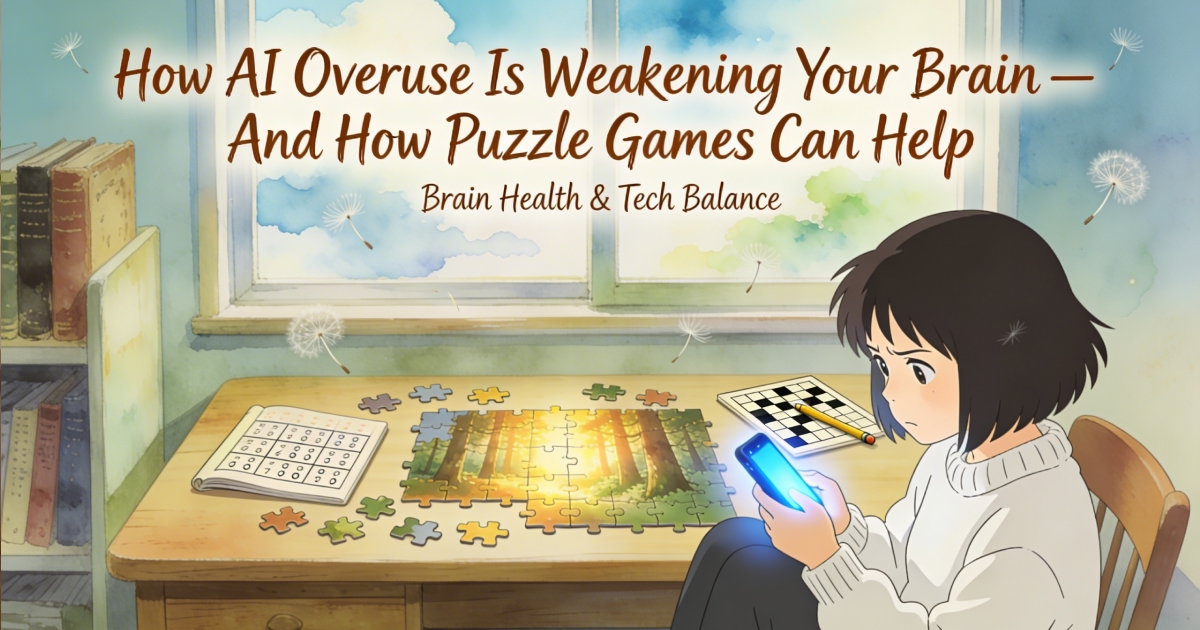
ChatGPT can write your emails, summarize your research, plan your meals, and even debug your code. AI tools have become astonishingly capable — and millions of people now rely on them for tasks they once handled with their own brains. But there's a growing concern among neuroscientists and cognitive researchers: the more we outsource our thinking to AI, the less our brains actually think.
This isn't anti-technology fear-mongering. It's a well-documented cognitive principle called the "use it or lose it" effect — and it applies to your brain just as much as it applies to your muscles. The good news? There are simple, enjoyable ways to fight back. Puzzle games, in particular, offer one of the most effective antidotes to AI-induced cognitive laziness.
The Rise of "Cognitive Offloading"
Cognitive offloading is the scientific term for using external tools to reduce the mental effort required for a task. Writing a grocery list is cognitive offloading. Using a calculator is cognitive offloading. And asking ChatGPT to think through a problem for you is cognitive offloading on steroids.
A 2024 study published in Nature Human Behaviour found that participants who frequently used AI assistants for problem-solving tasks showed measurably reduced performance when asked to solve similar problems independently. The effect was most pronounced in areas of critical thinking and creative reasoning — the very skills that make us uniquely human.
The problem isn't using AI occasionally. It's the pattern of defaulting to AI before even attempting to think. When you ask ChatGPT to draft every email, solve every problem, and make every decision, your brain's problem-solving circuits don't just rest — they begin to atrophy.
5 Ways Excessive AI Use Can Harm Your Brain
1. Weakened Critical Thinking
Critical thinking requires effort — evaluating evidence, weighing arguments, identifying biases. When AI does this for you, your brain skips the workout entirely. Over time, you may find it harder to form independent opinions or spot logical flaws in arguments. A 2025 survey by the American Psychological Association found that 67% of college professors reported a noticeable decline in students' ability to construct original arguments since the widespread adoption of AI writing tools.
2. Reduced Memory Formation
The act of struggling to recall information — what psychologists call "effortful retrieval" — is one of the most powerful ways to strengthen memory. When you Google or ChatGPT every question instead of trying to remember the answer first, you rob your brain of this strengthening process. This is an extension of what researchers have called the "Google Effect" — our tendency to forget information we know we can easily look up.
3. Diminished Problem-Solving Skills
Problem-solving is a skill that improves with practice and deteriorates without it. Every time you let AI solve a problem you could have worked through yourself, you miss an opportunity to strengthen your neural problem-solving pathways. This is especially concerning for younger users whose brains are still developing these critical circuits.
4. Shortened Attention Span
AI delivers instant answers, training your brain to expect immediate gratification. This erodes your ability to sit with a difficult problem, tolerate ambiguity, and persist through frustration — skills that are essential for deep work and meaningful achievement. The patience to work through complexity is a cognitive muscle, and AI is making it weaker.
5. Reduced Creative Thinking
Creativity emerges from the messy, nonlinear process of connecting disparate ideas. When AI generates ideas for you, your brain misses the creative struggle that produces genuine innovation. Research from the University of Cambridge found that people who brainstormed with AI produced more ideas but less original ones compared to those who brainstormed independently.
The Core Problem: AI doesn't just help you think — it thinks instead of you. And just like a muscle that's never used, a brain that's never challenged will gradually lose its strength.
The "Mental Gym" Solution: Why Puzzle Games Are the Perfect Antidote
If AI overuse is like sitting on the couch all day, puzzle games are like going to the gym for your brain. They force you to do exactly what AI discourages: think independently, struggle productively, and solve problems without external help.
Here's why puzzles are uniquely effective at counteracting AI-induced cognitive decline:
Puzzles Demand Active Thinking
Unlike passively consuming AI-generated content, puzzles require you to actively engage your brain. There's no shortcut, no "generate answer" button. You must observe, analyze, hypothesize, and test — the exact cognitive processes that AI threatens to make obsolete. When you sit down with a Sudoku Blox puzzle, your brain has no choice but to do the work itself.
Puzzles Rebuild Problem-Solving Pathways
Every puzzle you solve strengthens the neural pathways responsible for logical reasoning and pattern recognition. A study in the International Journal of Geriatric Psychiatry found that regular puzzle-solvers had brain function equivalent to people 8-10 years younger. This is the exact opposite of what AI overuse does to your brain.
Puzzles Train Patience and Persistence
In a world of instant AI answers, puzzles teach you to sit with difficulty. A jigsaw puzzle can't be rushed. A Sudoku grid can't be shortcut. The process of working through frustration and arriving at a solution through your own effort is profoundly rewarding — and it rebuilds the patience that AI erodes.
Puzzles Provide Healthy Dopamine
AI tools and social media hijack your dopamine system with instant gratification. Puzzles offer a healthier alternative: earned dopamine. The satisfaction of snapping a jigsaw piece into place or completing a logic grid comes from genuine accomplishment, not algorithmic manipulation. This trains your brain to associate reward with effort rather than passivity.
The Best Puzzle Games to Combat AI Brain Drain
Sudoku Blox — For Logic and Spatial Reasoning
Sudoku Blox combines the logical rigor of Sudoku with the spatial challenge of a block puzzle. It's the perfect daily brain workout — one fresh puzzle each day that takes 5-15 minutes and exercises both analytical and spatial thinking simultaneously. The daily format also creates a healthy routine without the risk of overuse.
Jigsaw Puzzles — For Visual Processing and Patience
Free online jigsaw puzzles are excellent for rebuilding patience and visual-spatial skills. The process of scanning, matching, and fitting pieces together engages your brain in a way that's meditative yet mentally stimulating. Unlike scrolling through AI-generated content, jigsaw puzzles require sustained attention and reward you for it.
Crosswords — For Memory and Language
Crossword puzzles force you to retrieve information from memory — the exact skill that AI dependency weakens. The struggle to recall a word or fact, even when it's on the tip of your tongue, is one of the best exercises for strengthening memory formation and retrieval.
Logic Puzzles — For Critical Thinking
Logic puzzles, including nonograms and deduction grids, require you to evaluate clues, eliminate possibilities, and build conclusions step by step. This directly exercises the critical thinking skills that AI threatens to erode.
Building a "Brain Protection" Routine
The goal isn't to stop using AI entirely — it's to ensure your brain stays sharp despite using it. Here's a practical daily routine:
- Morning puzzle (5-10 min) — Start your day with a Sudoku Blox puzzle or a quick Sudoku to activate your problem-solving circuits before you open any AI tools
- Think before you prompt — Before asking AI anything, spend 2 minutes trying to work through the problem yourself. Even a brief attempt strengthens neural pathways
- Midday brain break (5 min) — Replace a social media scroll with a jigsaw puzzle session. It's more relaxing and infinitely better for your brain
- Evening wind-down (10-15 min) — End your day with a puzzle instead of AI-generated entertainment. Crosswords, logic puzzles, or a longer jigsaw session all work well
- Weekly AI audit — Once a week, review how you used AI. Identify tasks where you could have thought independently and commit to doing so next time
The 2-Minute Rule: Before reaching for ChatGPT, give yourself 2 minutes to think about the problem independently. This simple habit can dramatically reduce cognitive offloading and keep your brain engaged. You'll often find that you knew the answer all along.
What the Research Says
The science supporting puzzle games as cognitive protection is robust:
- A 2019 study in the International Journal of Geriatric Psychiatry found that regular puzzle engagement was associated with brain function equivalent to 8-10 years younger
- Research published in JAMA Network Open (2023) linked daily puzzle-solving to a 29% lower risk of cognitive decline in adults over 50
- A BMC Psychiatry study showed that spatial puzzles like Tetris reduced intrusive thoughts by 62%, demonstrating puzzles' power to actively engage and protect the brain
- The University of Exeter's landmark study found that people who regularly solve number and word puzzles maintain sharper memory, attention, and reasoning well into old age
- A 2025 cognitive science paper demonstrated that participants who combined AI use with daily puzzle-solving showed no measurable decline in independent problem-solving ability, while those who used AI without puzzles declined significantly
It's Not About Rejecting AI — It's About Balance
AI is an incredible tool. It can amplify human productivity, unlock creative possibilities, and solve problems at a scale we never could alone. The issue isn't AI itself — it's the uncritical, reflexive dependency that many people are developing.
Think of it like a car. Driving everywhere is convenient, but if you never walk, your legs will weaken. AI is the car for your brain. Puzzle games are the daily walk that keeps your cognitive legs strong.
The people who will thrive in the AI age aren't those who use AI the most — they're those who maintain the sharpest independent thinking skills alongside AI. And one of the simplest, most enjoyable ways to do that is to make puzzle games a daily habit.
Keep Your Brain Sharp in the Age of AI
Try Sudoku Blox — a daily puzzle that exercises logic and spatial reasoning. Or solve a free jigsaw puzzle to rebuild patience and visual thinking. Your brain will thank you.
Or download Sudoku Blox:


Final Thoughts
The irony of this article isn't lost on us — you might be reading it after an AI tool recommended it. And that's fine. The point isn't to fear AI, but to recognize that your brain needs exercise just like your body does. Every time you solve a puzzle, you're telling your brain: I still need you. Stay sharp.
So the next time you're about to ask ChatGPT something, pause for a moment. Try thinking it through yourself first. And when you're done with work for the day, reach for a jigsaw puzzle or a round of Sudoku Blox instead of another AI-powered app. Your future self — with a sharper, more resilient brain — will thank you.